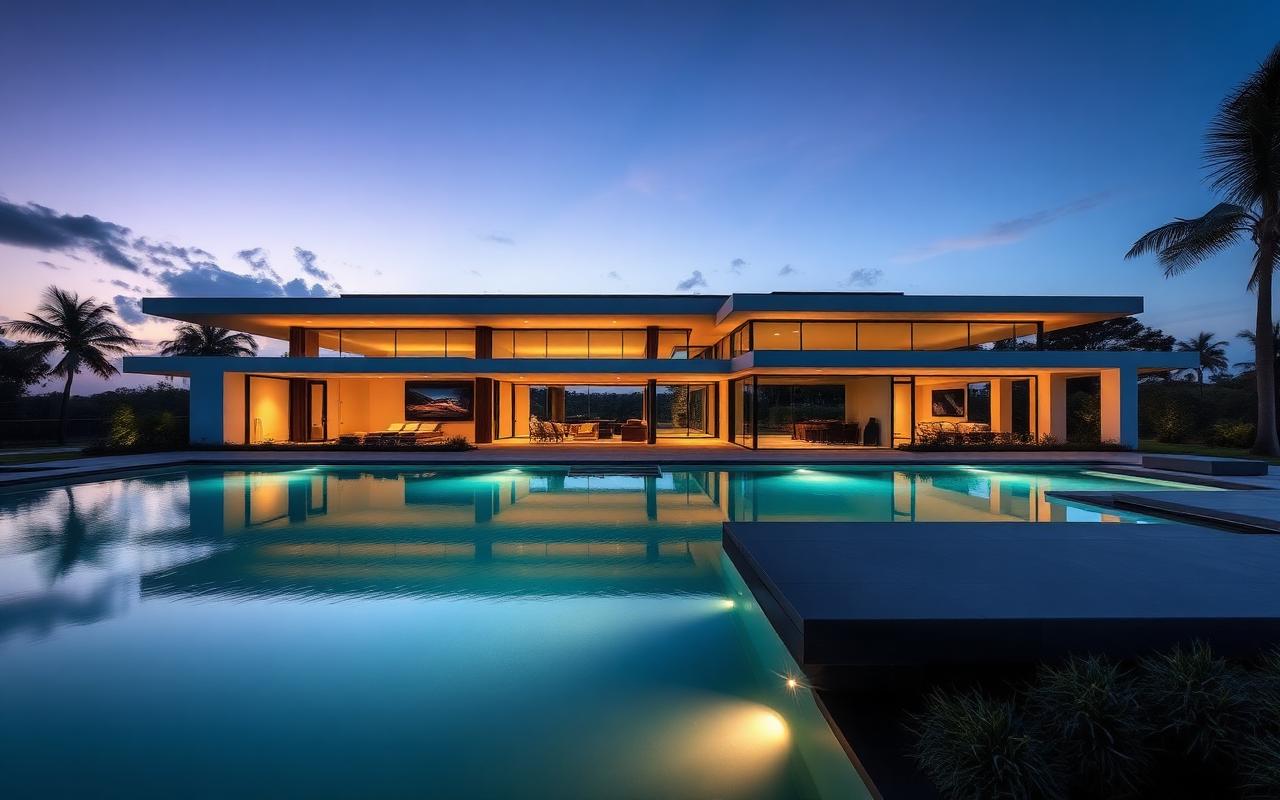
As the sun drops below the Gulf of Mexico and the sky cycles through its nightly palette of gold, coral, and violet, something remarkable happens to the finest homes on the Gulf Coast. They transform. The horizontal compositions that command attention by day become entirely different works of architecture at night — luminous, layered, and deeply atmospheric. This transformation is not accidental. It is the result of a lighting design discipline that has become one of the most important — and least understood — elements of Gulf Coast luxury architecture.
The Philosophy of Architectural Lighting
Great architectural lighting on the Gulf Coast begins with a counterintuitive principle: restraint. The goal is not to illuminate everything uniformly, but to create a composition of light and shadow that reveals the architecture's essential character. Walls become canvases. Textures emerge. Spaces acquire depth and mystery that daylight never suggests. The best lighting designers think of themselves as choreographers, directing attention through a sequence of illuminated moments.
Gulf Coast architecture presents unique opportunities for lighting design. The deep overhangs and horizontal planes characteristic of the region's best homes create natural shelves and coves for concealed fixtures. Outdoor living spaces — loggias, pool decks, garden courtyards — extend the lighting narrative beyond the building envelope into the landscape. And the proximity to water adds a reflective dimension that multiplies every lighting gesture.
Landscape Lighting as Art
The landscape surrounding a Gulf Coast home is where lighting design arguably reaches its highest art. Mature royal palms illuminated from below with warm narrow-beam fixtures become sculptural columns that define the property's vertical axis. Specimen trees — live oaks, banyans, tabebuias — become three-dimensional paintings when lit with carefully positioned fixtures that graze their bark and canopy from multiple angles.
“Light is the architect's most powerful material. It costs nothing to shape, weighs nothing to transport, and can transform a beautiful home into an unforgettable one.”
— Lighting designer James Corrado
Water features — pools, fountains, reflecting ponds — offer another dimension entirely. Underwater LED fixtures can wash pool walls in shifting colors or maintain a subtle glow that makes the water itself appear to emit light. Infinity-edge pools that reflect landscape lighting create the illusion of a luminous horizon that merges with the bay beyond. Fire features — gas-fired fire bowls, linear fire pits — add warm, flickering light that no electric fixture can replicate.
Interior Lighting Layers
Inside Gulf Coast luxury homes, lighting is designed in layers. Ambient lighting provides the base wash of illumination — typically from cove lighting concealed in architectural details, recessed linear fixtures, or indirect uplighting that bounces light off ceilings. Task lighting is addressed through focused fixtures: pendants over kitchen islands, reading lights flanking beds, picture lights above artwork. Accent lighting — the layer that creates drama — highlights architectural features, art collections, and sculptural objects.
The integration of art and lighting has become particularly sophisticated. Museum-quality picture lights — framing projectors that shape light to precisely match the dimensions of a painting — are now standard in luxury installations. Some homeowners commission lighting scenes specifically designed for their art collections, with different settings that emphasize different works depending on the time of day or the mood of the evening.
Control and Intelligence
Modern lighting control systems — Lutron Homeworks, Crestron, Savant — have transformed how Gulf Coast residents experience their homes. A single button press can transition from a bright, energizing morning scene to a warm, intimate dinner party setting. The best installations include astronomical time-clock programming that adjusts exterior lighting automatically based on sunset and sunrise times, ensuring the landscape is perfectly illuminated year-round without manual intervention.
Circadian lighting — systems that adjust color temperature throughout the day to support the body's natural rhythms — is the latest frontier. Morning light skews cool and energizing (4000K-5000K); evening light warms to the amber tones of candlelight (2200K-2700K). The transition is gradual and usually imperceptible, but residents report improved sleep quality and a greater sense of well-being. For a region where lifestyle and wellness are central to the real estate proposition, circadian lighting is a natural fit.
The Investment in Light
Professional lighting design for a Gulf Coast luxury residence typically represents 3-5% of the total construction budget — a modest investment that disproportionately affects how the home is experienced. A $5 million home with a $200,000 lighting budget will feel more luxurious, more comfortable, and more architecturally resolved than a $7 million home with builder-grade lighting. It is, in the estimation of many architects and designers, the single most impactful investment in a luxury home.
For those building or renovating on the Gulf Coast, the message is clear: lighting is not an afterthought. It is one of the primary tools through which architecture comes alive. The homes that captivate — the ones that stop you mid-step as you drive along Gulf of Mexico Drive at dusk — are invariably the ones where someone thought deeply about light. On the Gulf Coast, where the natural light show is already spectacular, the best homes answer the sunset with a performance of their own.
Explore the Neighborhoods
Discover the areas mentioned in this article